The analysis published in Eesti Päevaleht rests on misleading data and does not reflect reality. It gives the reader a distorted picture of both prices and the role of retail chains in shaping them. The reason food is so expensive in Estonia is that VAT makes up a substantial share of a product's final price.
I want to refute the claims that have been making the rounds in the media recently, suggesting that increased markups by retail chains are behind Estonia's high food prices. In reality, retailers' markups have been getting smaller year by year, while at the same time the tax burden and the share of consumers who prefer to buy food at promotional prices have only been growing.
The analysis by Erik Moora published in the opinion section of Eesti Päevaleht, claiming that high food prices are driven by increased markups by Estonia's retail chains, was no doubt a worthy attempt to spell out for the consumer, in black and white, how the prices of staple foods are formed.
In my view, the examples in the article did not reflect reality but instead misled the reader by showing retailers' markups, depending on the product, as up to seven times higher than they actually are.
The figures used in the article differ from reality
Let me illustrate, with a few of the more striking examples, how the price of the food items covered in the article actually breaks down, how much of it is the retailer's share and how much is VAT.
These figures are based on our day-to-day experience, which is how we put food on the table for every fourth Estonian. For each category, we have shown a weighted average that takes both regular and promotional prices into account.
For carton milk, the article gave an average price of 1.30 €/l for the first quarter of 2025. In reality, Estonians consume carton milk at an average price of 1.06 €/l. The article's example shows the retailer's markup as 36 cents; in reality it is 10 cents per litre.
That is roughly 3.5 times less than what the article claimed and amounts to under 10% of the milk's price. At the same time, VAT makes up close to 20% of the price. In the third quarter of 2025, the retailer's markup has fallen to 6.4 percent. In other words, retailers' markups are decreasing rather than increasing as the article claimed.
For Edam sliced cheese, the first thing to say is that this is not the main type of cheese Estonians buy. For example, in the cheese turnover of the Coop retail chain, Edam cheeses sold in our stores account for a very small share, just 3.3%.
The article gave the average price of Edam cheese in the first quarter of 2025 as 12.38 €/kg. In reality, Estonians consume Edam sliced cheese at an average price of 7.97 €/kg. That is a 50% difference from the figure in the article. Once again, this shows that the data used in the article is very different from reality.
The article showed the retailer's markup as 4.8 €/kg; in reality it is under 90 cents. That is five times less than the article said and amounts to a little over 10% of the price.
Meanwhile, VAT makes up over 18% of the price. In the third quarter of 2025, the retailer's markup has fallen to 10 percent. At the same time, VAT already accounts for 19.5% of the price of Edam sliced cheese.
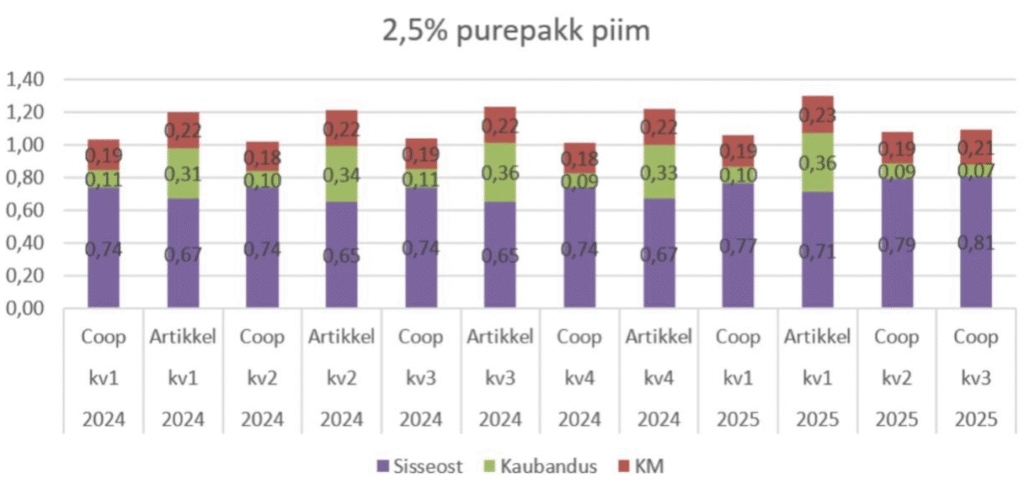
The next three examples in the article also contain errors of the same magnitude as those described above and do not match the actual structure of consumption or the actual price level.
The price levels cited in the article differ from reality by as much as 50%, and the markups attributed to retailers are shown to be up to seven times higher than they actually are.
Coop's data clearly show that in the first to third quarters of 2025, the retailer's markup has decreased and the share of VAT in the price of every product has grown. As a result, in these examples VAT has the largest share of the price after the farmer and the producer, while the retailer's markup has the smallest.
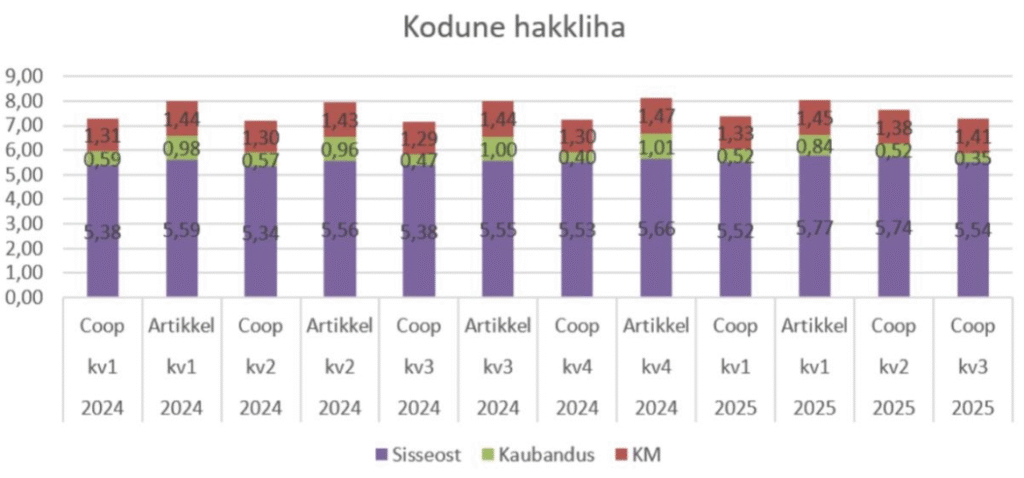
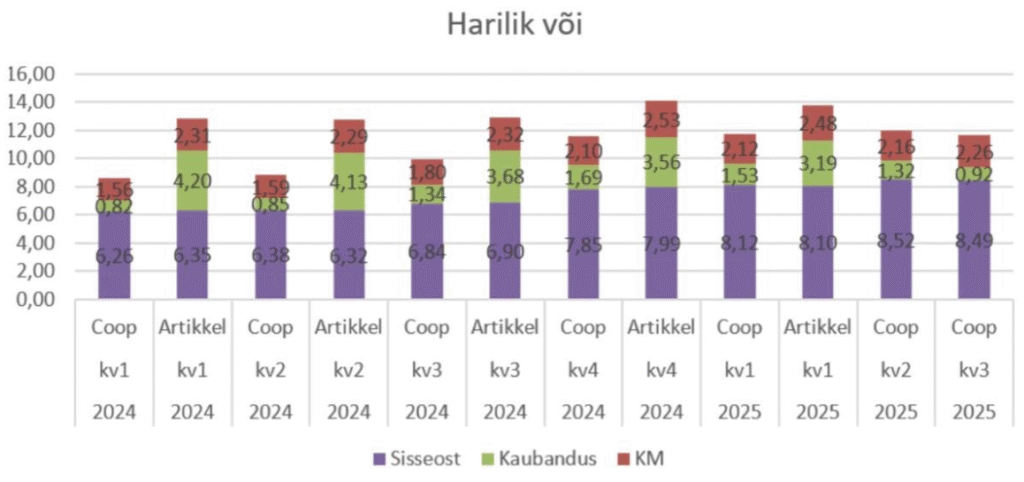
As is clear from the above, these differences really are very large. They illustrate how limited the publicly available data and its previous interpretations actually are. They cannot give an adequate picture of the real situation in the Estonian retail market, because they do not use the right underlying data and do not take society's consumption structure into account.
The structure of consumption is shaped by what the Estonian consumer actually puts in their basket in the store. If they only buy products at the regular price — which are not staple foods — then yes, they really are consuming higher-markup products. However, regular-priced products are not a significant part of the average Estonian's grocery basket. We all know from our trips to the shop that this is not how it works: I, like 99% of Estonians, look very carefully at what I put in the basket at the grocery store, choosing on the basis of preference and price comparisons.
I would say that Erik Moora's analysis only holds true for the 1% of Estonian consumers who do not have to look at prices in the store and buy only the most expensive regular-priced foods. It is not, however, valid to draw conclusions from that 1% about the grocery baskets and store markups of the other 99% of Estonians.
For some time now, both Coop and other Estonian retail chains have been pointing out that the share of discounted goods in consumers' baskets has grown noticeably in recent years. That aspect, however, has been left out of this article and several others published in the media recently.
Equally little attention has been given to the fact that price formation in stores depends on a great many different factors — the global price of raw materials, producers' costs in Estonia and abroad, the retail chain's costs for stores and staff, and VAT.
The share of VAT has become significant
It is precisely the role of VAT that has been downplayed or ignored in the formation of final food prices. Since VAT in Estonia has been 24% from 1 July of this year, the biggest lie is that VAT does not play a significant role in shaping food prices.
Everyone knows that if you have a four-slice pizza and four people in the family, everyone gets a slice. But if there is also a fifth member of the family who always has first claim on a slice (the 24% VAT rate), then only three slices are left for the other four to share among themselves.
So the claim that VAT does not play a significant role in food price formation and does not make up a quarter of every Estonian's dining table simply does not hold true.
I too am an Estonian patriot and ready to pay higher taxes to ensure Estonia's security, but that contribution must be assessed by the country's leaders alongside its residents.
A good and cohesive society can exist only when the parliament and government chosen by the people serve the people's interests and take account of the prevailing mood in society and people's needs. Anything else creates distance between the government and society, fertile ground for the development of various extremist movements.
Estonians have already gathered close to 75,000 signatures asking for VAT on food to be lowered, but this is still being ignored. Of course, no government can rush to cut taxes at every initiative, but no self-respecting head of government can look past such an overwhelming wish — a public debate must be opened on this topic!
Today, we have not seen one, and it does not look as if one is being planned.
Calling for a year now for VAT to be lowered instead
Of course, the cost to the budget of cutting VAT on every grocery item would be high.
For a year now I have been saying that food VAT should be cut only on staple foods, the kind that are in every Estonian's grocery basket regardless of income level and that are produced primarily in Estonia.
That would simultaneously ensure better food security, additional revenue for the state from production-related taxes, and cleaner food on Estonians' tables.
Of course, you could say that this is just one Estonian retail chain talking and only serves the chain's own interests. Let me confirm that this is not so. If VAT is cut on meat, dairy and vegetables, that would mean the state collects only 29 million euros less in tax revenue per year. It would not fall by 240 million euros, as the government claims.
The food categories proposed by Coop are the ones that all Estonian retailers sell with the lowest markups and that belong in every Estonian's grocery basket.
If the structure of consumption shifts even further in their favour, that is more harmful for the retailer. Working in this field, I cannot find a motive for why this should be advantageous for the retailer, but that is the narrative the public is being fed about this proposal.
Why, then, do various retail chains support this change? We support it because we are concerned about Estonian farmers and food producers, and about the health of Estonians, both today and in the future.
We hear that the Health Insurance Fund is heavily in the red and no one knows how the state budget will cope with healthcare spending in the future. Today's poor diet will only escalate that problem in the years to come.
The article appeared in Eesti Päevaleht on 27 July 2025
RESPONSE | Rainer Rohtla: EPL's food price analysis is misleading. Such markups are paid only by the wealthiest 1%.
PHOTO: Anni Õnneleid | Delfi Meedia